

Most investors leave those advantages on the table. They treat tax planning as a December activity rather than a year-round discipline, and they miss decisions made at acquisition, mid-ownership, and exit that dwarf any year-end move.
This guide covers how rental income is taxed, the most valuable deductions, advanced strategies like cost segregation and Real Estate Professional Status, capital gains planning tools, and the mistakes that quietly cost investors the most.
Key Takeaways
- Rental income is passive income — not subject to FICA tax, unlike wages or self-employment income
- Depreciation frequently creates a paper tax loss even when cash flow is positive
- Cost segregation, bonus depreciation, Real Estate Professional Status (REPS), and the STR loophole can eliminate five- or six-figure tax bills
- 1031 exchanges and Qualified Opportunity Zones defer or eliminate capital gains taxes on property sales
- Tax planning delivers the most value when coordinated with retirement, estate, and investment strategy — not as a once-a-year afterthought
How Real Estate Income Is Taxed — And Why It's a Built-In Advantage
The FICA Savings Are Real and Substantial
The U.S. tax system divides income into three buckets: earned income (W-2 wages or self-employment), passive income (rentals), and portfolio income (stocks, bonds). Where your income falls determines far more than your rate. It also determines which other taxes apply.
Per IRS Topic 751, the combined FICA rate is 15.3% — 6.2% Social Security and 1.45% Medicare, split between employer and employee. Self-employed individuals pay both sides.
Rental income is explicitly excluded from self-employment earnings under IRC §1402(a)(1). That means a real estate investor earning $100,000 in net rental income saves up to $15,300 in FICA taxes compared to a self-employed person at the same income level.
High earners also face a 3.8% Net Investment Income Tax on rental income, but that's still a fraction of the FICA exposure on earned income.
The Depreciation Math: Positive Cash Flow, Negative Taxable Income
Here's a simplified example of how depreciation reshapes the tax picture:
| Item | Amount |
|---|---|
| Gross rental income | $36,000 |
| Operating expenses | ($10,000) |
| Mortgage interest | ($12,000) |
| Annual depreciation (27.5 years) | ($16,000) |
| Net taxable income (loss) | ($2,000) |
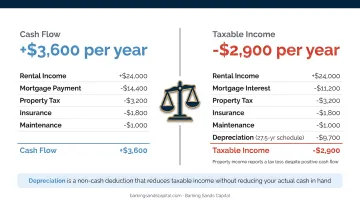
The investor pockets positive monthly cash flow but reports a $2,000 loss for tax purposes. That paper loss either offsets passive income from other rentals or carries forward — depending on the investor's situation.
Passive Activity Loss Rules: Who Gets to Use Those Losses
IRS Publication 925 classifies rental activities as passive by default, meaning losses generally can only offset passive income — not W-2 wages.
Two exceptions matter most:
- $25,000 special allowance for active participants with MAGI below $100,000; phases out dollar-for-dollar above $100,000 and disappears at $150,000
- Real Estate Professional Status (REPS), which removes the passive classification entirely — losses can offset W-2 or business income with no cap (covered in the next section)
Suspended losses don't disappear — they carry forward on Form 8582 and become deductible upon a fully taxable disposition of the property.
Deductions Every Real Estate Investor Should Be Claiming
Core Operating Deductions
Rental property owners report income and expenses on Schedule E (Form 1040). Deductible operating expenses include:
- Mortgage interest
- Property taxes and insurance premiums
- Repairs and maintenance
- Property management fees
- Advertising costs
- Professional fees (legal, accounting)
- Utilities paid by the owner
These reduce taxable rental income dollar-for-dollar and apply to every rental property, regardless of size.
Depreciation: Mandatory, Not Optional
IRS Publication 527 allows investors to deduct the cost of the building (not land) over its useful life — 27.5 years for residential rental property, 39 years for commercial. On a $400,000 building, that's roughly $14,545 per year in residential depreciation — every year, whether the property appreciates or not.
Depreciation is required, not optional. IRS Publication 544 specifies that basis must be reduced by depreciation "allowed or allowable" — the IRS will assess recapture at sale even if you never claimed the deduction. Two steps every investor should take at acquisition:
- Allocate purchase price between land and building using the property tax assessor card
- Document the split clearly — it determines your annual deduction and your recapture exposure at sale
Cost Segregation and Bonus Depreciation
A cost segregation study is an engineering-based analysis that reclassifies building components — appliances, carpeting, specialty plumbing, landscaping — from 27.5-year or 39-year property into 5-, 7-, or 15-year property. According to the American Society of Cost Segregation Professionals (ASCSP), this front-loads depreciation into early ownership years, often doubling or tripling first-year write-offs.
Whether a study makes financial sense depends on the property's size, complexity, available records, and whether a site inspection is required.
Under the One Big Beautiful Bill Act (OBBBA), signed into law on July 4, 2025, 100% bonus depreciation was permanently restored for qualifying property acquired and placed in service after January 19, 2025. When a cost segregation study identifies short-life assets, bonus depreciation allows investors to expense those assets entirely in the year placed in service rather than depreciating them over 5 to 15 years. The upfront tax savings can be significant, but those deductions don't disappear permanently — depreciation recapture is taxed at up to 25% when you sell, so model that exposure before you execute.
The Repair vs. Capital Improvement Distinction
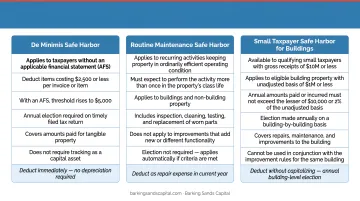
Repairs are fully deductible in the current year. Capital improvements must be capitalized and depreciated. Three IRS safe harbors help:
- De Minimis Safe Harbor: Deduct items up to $2,500 per invoice without capitalizing (per IRS Notice 2015-82)
- Routine Maintenance Safe Harbor: Recurring activities expected to recur within a 10-year period may qualify under Treas. Reg. §1.263(a)-3(i)
- Safe Harbor for Small Taxpayers: Applies to buildings under $1 million in unadjusted basis for taxpayers with average gross receipts under $10 million, with a deduction cap of the lesser of $10,000 or 2% of unadjusted basis
Advanced Strategies to Significantly Reduce Your Tax Bill
Real Estate Professional Status (REPS)
REPS is the single most powerful tax strategy for high-income investors. Under IRC §469(c)(7), qualifying means rental losses become non-passive and can offset W-2 or business income with no dollar limit.
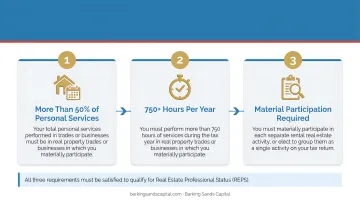
Requirements:
- Spend 750+ hours per year in real property trades or businesses
- More than half of all working hours must be in real estate activities
- Material participation in each rental activity (typically 500+ hours, or 100+ hours if more than any other person)
Only one spouse needs to qualify. When combined with cost segregation and 100% bonus depreciation, REPS can eliminate six-figure tax bills for high-income professionals or business owners with significant rental portfolios.
The Short-Term Rental (STR) Loophole
For investors who don't qualify for REPS, the short-term rental loophole offers an alternative path. Under 26 CFR §1.469-1T(e)(3)(ii)(A), a property is not treated as a rental activity if the average guest stay is 7 days or fewer.
That reclassification removes the automatic passive-activity label. If the investor also materially participates — handles bookings, pricing, guest communications, and maintenance — losses become non-passive and can offset W-2 income. This is the path many Airbnb and VRBO hosts use to create meaningful deductions without leaving their day jobs.
The QBI Deduction and Retirement Accounts
Qualifying real estate investors may deduct up to 20% of qualified business income under the TCJA's §199A deduction. The Rev. Proc. 2019-38 safe harbor allows rental real estate enterprises to qualify as a trade or business, provided they meet a 250-hour rental services requirement and maintain separate books.
For 2025, the QBI deduction begins phasing out at $394,600 for married filing jointly and $197,300 for other filers, per IRS Form 8995 instructions.
Retirement accounts add another layer of tax reduction. For 2025:
- Solo 401(k): Up to $23,500 in elective deferrals, $70,000 total contribution limit; age 60–63 catch-up is $11,250 under SECURE 2.0
- SEP IRA: Up to 25% of compensation or $70,000, whichever is less
Contributions reduce taxable income dollar-for-dollar. Self-directed versions allow real estate holdings inside the account — though debt-financed property can trigger Unrelated Debt-Financed Income (UDFI) analysis under IRC §514. That distinction matters differently for IRAs versus qualified plans, and getting it wrong can create unexpected tax exposure.
Where Integrated Planning Matters Most
Each of these strategies interacts with the others. Accelerating depreciation affects bracket positioning. Retirement account contributions shift how much QBI you can deduct. Choosing the wrong retirement vehicle can negate gains made elsewhere.
That's where siloed tax preparation breaks down. Barking Sands Capital's InteProcess™ coordinates tax, retirement, estate, insurance, and investment planning as a single strategy — so a decision made in one area doesn't quietly cost you in another.
Capital Gains Planning: Smart Strategies for When You Sell
The 1031 Exchange
A 1031 like-kind exchange allows investors to sell one investment property, roll the proceeds into a replacement property, and defer all capital gains taxes and depreciation recapture. Per IRS guidance, the rules are strict:
- Replacement property must be identified within 45 days of closing
- Transaction must close within 180 days
- A Qualified Intermediary must hold proceeds — the investor cannot take constructive receipt
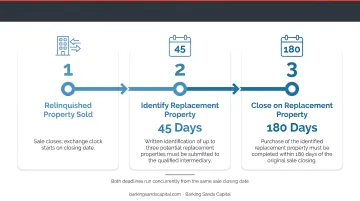
There's no limit on how many exchanges an investor can complete — each one that independently satisfies IRC §1031 defers the gain. Chains of exchanges, combined with estate planning, can defer taxes across an entire investment lifetime.
Qualified Opportunity Zones
Qualified Opportunity Zone (QOZ) funds offer a flexible alternative. Investors reinvest only the capital gain (not full proceeds) into a Qualified Opportunity Fund within 180 days. The OBBBA permanently extended the QOZ program, per IRS guidance on OBBBA provisions and PwC's analysis.
Under original TCJA mechanics (as confirmed by IRS):
- Only the capital gain is reinvested — the remaining sale proceeds remain liquid
- Tax on the invested gain is deferred, with a 10% basis step-up after 5 years and an additional 5% after 7 years
- Investments held 10+ years may exclude all appreciation from tax entirely
QOZ investments concentrate capital in a single designated area, which limits diversification and liquidity. Expect to commit capital for at least 10 years to capture the full tax benefit.
Two Additional Exit Tools
- Installment sales: Spread taxable gain across multiple years under IRC §453, keeping annual income below bracket thresholds
- Step-up in basis at death: Heirs inherit property at fair market value under IRC §1014, eliminating accumulated capital gains — making real estate a powerful multigenerational wealth transfer vehicle when paired with estate planning
Common Tax Mistakes Real Estate Investors Make
Recordkeeping and Classification Errors
Three mistakes consistently cost investors money:
- Incorrect land/building allocation at acquisition — leads to overstated or understated depreciation, with recapture consequences either way
- Misclassifying capital improvements as repairs — creates a current-year deduction that won't survive audit scrutiny
- Failing to track suspended passive losses on Form 8582 — investors lose the ability to unlock those losses at a qualifying event (property sale, passive income, or REPS qualification)
Waiting Until December
Decisions with the largest tax consequences — which entity structure to use, whether to order a cost segregation study, how to exit a property — happen mid-year, not at filing time. Year-end moves have limited impact compared to decisions made during the year with a qualified advisor.
The missing piece for many real estate investors isn't compliance — it's coordination. A CPA handles the return, but without an advisor connecting tax strategy to retirement income, investment allocation, and estate planning, decisions in one area can quietly undermine another. Barking Sands Capital's fee-based, independent advisory model is designed around that coordination, so tax planning doesn't happen in isolation from the rest of your financial picture.
Frequently Asked Questions
What is the 3-3-3 rule in real estate?
The 3-3-3 rule is a personal finance guideline: spend no more than one-third of gross income on housing, keep one-third for expenses, and save one-third. An affordability screening tool rather than a tax strategy, it can inform acquisition decisions within a broader financial plan.
What is the 7% rule in real estate?
The 7% rule suggests that annual gross rental income should equal at least 7% of a property's purchase price to be considered cash-flow positive. As an acquisition screening metric, investors should also factor in depreciation benefits and net tax impact when evaluating true after-tax returns.
How does depreciation recapture work when I sell a rental property?
When you sell, the IRS taxes accumulated depreciation deductions at up to 25% (unrecaptured §1250 gain), in addition to capital gains tax on any additional appreciation. This applies to depreciation "allowed or allowable" (even deductions you never took). A 1031 exchange or step-up in basis at death are the primary tools for deferring or eliminating recapture.
Can I use rental property losses to offset my W-2 income?
Rental losses are passive and can only offset passive income. Two exceptions apply: the $25,000 special allowance for active participants with MAGI below $150,000, and Real Estate Professional Status (REPS), which reclassifies losses as non-passive with no offset cap.
What is a 1031 exchange and how does it work?
A 1031 exchange defers capital gains and depreciation recapture by selling one investment property and reinvesting proceeds into a like-kind replacement. A Qualified Intermediary holds funds during the transaction; the investor has 45 days to identify a replacement property and 180 days to close.
Do I need an LLC to invest in real estate?
An LLC primarily provides liability protection; it doesn't inherently reduce taxes on rental income. Using the wrong entity type (S-Corp or C-Corp) for rental holdings can create unintended tax consequences, including double taxation or built-in gains exposure. Consult both a tax professional and a licensed attorney before forming any entity.
This article is for educational purposes only and does not constitute tax, legal, or financial advice. Consult a qualified tax professional and financial advisor regarding your specific situation.