
Introduction
Most parents want to fully fund their child's college education. Most parents also have credit card debt to pay down, a retirement account that needs attention, an emergency fund that isn't quite where it should be, and maybe a home purchase on the horizon. Doing all of these simultaneously — on a real, finite income — is genuinely hard.
You don't have to choose one goal over all others. You just need to sequence them correctly — and start before the math turns against you.
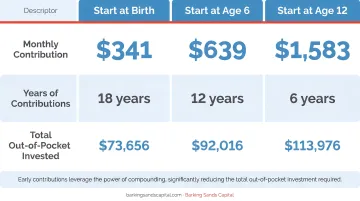
According to Vanguard's college savings projections, a family targeting $97,000 in college savings needs roughly $250/month if they start at birth — but that figure jumps to $450/month if they wait until age six, and $1,100/month starting at age twelve. The cost of waiting isn't just financial stress; it's lost time that compounding can't recover.
What follows is a practical framework for deciding which goals come first, which accounts to use, and how to make real progress without sacrificing retirement security to fund a college degree.
Key Takeaways
- Retirement savings always come first — you can borrow for college, but not for retirement.
- Build your financial foundation (emergency fund + high-interest debt paid down) before aggressively funding a 529.
- The one-third model splits college costs across pre-saved funds, current income, and financial aid or loans.
- Parent-owned 529 plans count at just 5.64% of account value in FAFSA calculations — minimal aid impact.
- Automating contributions across all goals simultaneously beats trying to perfectly time each one.
Establish a Financial Priority Order Before Saving for College
Most families run into trouble not because they lack discipline, but because they try to contribute equally to everything at once. When everything is a priority, nothing gets enough. A clear sequence fixes this.
Retirement Comes First — Without Exception
Retirement savings must be protected before college savings begin. You cannot take out a loan to fund your retirement, but students can borrow for college. Every dollar pulled away from your retirement account today doesn't just disappear — it loses decades of compound growth that can never be recovered.
If your employer offers a 401(k) or 403(b) with a matching contribution, capture the full match before directing a single dollar toward college savings. Skipping the match is declining part of your compensation.
There's also a FAFSA advantage worth noting. Per Federal Student Aid guidance, retirement plan values — including 401(k)s, IRAs, and pension funds — are excluded from FAFSA asset calculations entirely. Contributing more to retirement doesn't hurt your child's financial aid eligibility.
Fidelity recommends saving at least 15% of pretax income annually for retirement, including any employer match. Vanguard corroborates this with a 12–15% range. Hit that target first.
Then Comes College Savings
Once retirement contributions are on track — ideally at or near 15% of gross income — families can begin directing resources toward college. The sequence matters, but it's not all-or-nothing — both goals can run in parallel once retirement is properly funded.
College costs are substantial. According to College Board's 2025–26 data, average published tuition and fees alone break down as follows:
- Public in-state: $11,950 per year
- Public out-of-state: $31,880 per year
- Private nonprofit: $45,000 per year
None of those figures include room, board, or books — making the full four-year cost significantly higher for most families.
Build Your Financial Foundation First
Before accelerating 529 contributions, two foundational items need attention: a funded emergency reserve and high-interest consumer debt.
Why this order matters:
- An underfunded emergency fund means any unexpected expense — car repair, medical bill, job disruption — will force you to raid the college account you've been building.
- High-interest debt destroys financial progress faster than a 529 can grow. The Federal Reserve's 2025 credit card profitability data shows average credit card rates around 21.5%, with some consumers facing rates above 28%. Paying down 20–28% APR debt is mathematically equivalent to earning that same return, guaranteed. No investment vehicle can replicate that.
The standard emergency fund target is 3–6 months of essential expenses in an accessible account. Reach that benchmark before aggressively funding college savings.
That said, college savings don't have to wait until every other box is checked. Families can start a 529 with modest, automated contributions — $50–$100/month — while simultaneously building their emergency fund and eliminating consumer debt. The goal is balance, not delay.
How Much Do You Actually Need to Save for College?
Here's where many parents get derailed: they calculate the full projected four-year cost, feel overwhelmed, and either save nothing or divert too much from retirement.
The One-Third Model
A more sustainable approach is the one-third model, referenced by college planning resources like Saving for College:
- Save one-third of projected costs in advance (your 529 contributions)
- Pay one-third from current income during the college years
- Cover the final third through scholarships, student work, and modest loans
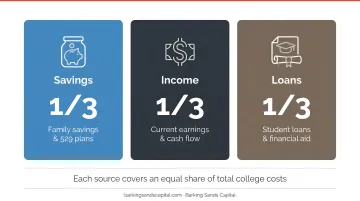
This reframes the goal from "fund 100% of college" to "save enough that the rest is manageable." It also removes the pressure to overfund a 529 at the expense of retirement.
Project Your Target
Use a college savings calculator — Saving for College, Fidelity, and Vanguard all offer them — with an assumed annual tuition inflation rate of approximately 5% (the commonly used planning assumption) and your child's current age. This gives you a specific monthly savings target to work toward.
You don't need to fund the full projected sticker price. Scholarships, grants, work-study, and reasonable student loans are all part of a sound funding plan — building them into your strategy from the start is smart planning, not a shortfall.
Choosing the Right College Savings Account
The right account meaningfully affects how much actually reaches college. Tax advantages, flexibility, and financial aid impact vary significantly.
529 Plans: The Primary Vehicle for Most Families
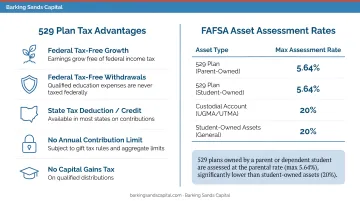
529 plans are the most widely used and tax-efficient option:
- Contributions grow tax-free
- Qualified withdrawals (tuition, room and board, books, fees) are federally tax-free
- Many states offer a state income tax deduction or credit for contributions
- Parent-owned accounts are assessed at only 5.64% of account value in FAFSA calculations, compared to up to 20% for student-owned assets
Two features reduce the main downside risk of 529s:
SECURE Act 2.0 rollover provision: Unused 529 funds — up to $35,000 lifetime — can be rolled into a Roth IRA for the original beneficiary. The account must be at least 15 years old, and annual Roth IRA contribution limits apply. This removes much of the "over-saving" risk, making a 529 a more versatile part of a long-term financial plan.
Grandparent contributions: Under updated FAFSA rules, grandparent-owned 529 distributions no longer reduce financial aid eligibility. Grandparents can now contribute directly — or redirect birthday and holiday gift money — without affecting a student's aid package.
Coverdell ESAs and Roth IRAs: Secondary Options
| Account | Key Benefit | Key Limitation |
|---|---|---|
| Coverdell ESA | Covers K–12 and higher education expenses | $2,000/year contribution cap; income phaseouts apply |
| Roth IRA | Contributions (not earnings) withdrawable penalty-free | Distributions count as income on FAFSA, reducing aid eligibility |
For most families, the 529 remains the most efficient vehicle for education-earmarked dollars. The Coverdell's $2,000 annual cap limits its practical usefulness to a supplemental role. Roth IRAs offer real flexibility, but their FAFSA treatment can quietly undercut that advantage — distributions count as student income, which can reduce aid eligibility dollar-for-dollar.
Practical Strategies to Balance College Savings With Your Other Goals
Knowing the right priority order is useful. Turning that order into consistent action is what actually changes the outcome.
Automate Everything
Set up automatic monthly contributions to your retirement account, 529 plan, and emergency fund simultaneously. When saving happens before discretionary spending, you stop making it an emotional monthly decision. Each goal becomes a fixed expense, not a judgment call.
Start Small and Scale Up
Families don't need to start large. Contributing $50–$100/month to a 529 when a child is young, then increasing contributions as income grows or debts are paid off, builds real balances over time.
A $1,000 contribution at birth, growing at a hypothetical 6.7% annual return, compounds to roughly $3,207 by age 18. That's the math behind asking grandparents and family members to contribute to the 529 instead of buying toys.
Use a Holistic Financial Plan
College savings, retirement planning, tax strategy, and insurance aren't separate decisions — they affect each other directly. An overfunded 529 can complicate financial aid. A gap in insurance coverage can derail any savings plan.
This is why coordinated planning matters. At Barking Sands Capital, the InteProcess™ framework aligns education funding, retirement projections, and tax strategy within a single client plan. CFP® Andrea Cervena works with families on education funding as part of this integrated work, helping ensure college savings goals don't crowd out retirement security.
Involve Older Children in the Conversation
Share the family's savings target with teenagers. Discuss scholarship opportunities, expected student contributions from part-time work, and what a reasonable loan amount looks like relative to expected post-graduation income. Setting expectations early reduces pressure on parents and prepares students for responsible financial decisions throughout college.
When to Revisit and Adjust Your College Savings Plan
A college savings plan set up today won't be perfectly suited to your situation in five years. Life changes warrant regular reassessment.
Review your plan annually, especially after:
- A new child is born
- Significant income change (raise, job loss, career shift)
- A financial setback requiring emergency fund drawdown
- Major debt milestones (mortgage payoff, student loans eliminated)
Shift Your Investment Allocation as College Approaches
529 plans offer age-based portfolios that automatically shift from equity-heavy allocations to more conservative bond-heavy mixes as the enrollment date nears. This glide path protects accumulated savings from a market downturn just before tuition is due. The process isn't fully passive — an annual check-in ensures the allocation still reflects your timeline and risk tolerance.
If You're Behind, You Have Options
Even with solid investment protection, a savings gap may still emerge as college approaches. That's a planning input, not a crisis. Constructive responses include:
- Choose in-state public universities to reduce tuition costs substantially
- Start at a community college for the first two years, then transfer to a four-year school
- Pursue merit scholarships and need-based grants to reduce out-of-pocket costs
- Supplement savings with part-time work during college
- Federal student loans kept within reasonable limits relative to expected starting salary
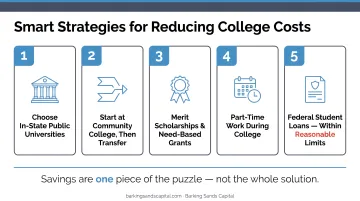
Savings are one piece of the puzzle — not the whole solution. A realistic plan from the start builds in multiple funding sources so a gap doesn't derail the goal.
Frequently Asked Questions
What is the 3-3-3 rule for savings?
In college funding, the one-third model suggests saving one-third of projected costs ahead of time, paying one-third from current income during college, and covering the final third through scholarships, student earnings, and modest loans. It's a useful framework for making college funding feel manageable rather than overwhelming.
What is the 50/30/20 rule for college students?
The 50/30/20 rule allocates after-tax income as: 50% to needs (rent, food, utilities), 30% to wants (entertainment, dining out), and 20% to savings and debt repayment. Parents can use this same framework to balance college savings contributions within their monthly household budget.
What is the 3-6-9 rule in finance?
The 3-6-9 rule is a guideline for emergency fund sizing: 3 months of expenses for single adults with stable income, 6 months for most families, and 9 months for self-employed individuals or those with variable income. Build to your appropriate tier before increasing 529 contributions.
Should I stop contributing to retirement to save more for college?
No. Pausing retirement contributions costs you irreplaceable compound growth — college can be partially funded through loans, scholarships, and aid in ways retirement cannot. Even a few missed years in your 30s or 40s creates outsized long-term consequences.
Does a 529 plan affect financial aid eligibility?
Parent-owned 529 plans have minimal impact on federal financial aid. Only about 5.64% of the account's value is counted in FAFSA calculations, compared to up to 20% for student-owned assets. This makes parent-owned 529s significantly more aid-friendly than most alternatives.
How much should I be saving for college each month?
Use a college savings calculator with your child's current age and an assumed 5% annual tuition inflation rate to set a target. Even modest contributions compound significantly over 18 years — starting matters more than starting perfectly, so begin now and increase contributions as your income grows.