

Introduction
According to the Administration for Community Living, someone turning 65 today has nearly a 70% chance of needing long-term care at some point — yet most families haven't set aside nearly enough to cover it. The median household age 75+ holds about $50,000 in financial assets, while a private nursing home room now costs over $129,000 per year.
That gap leaves most families one health event away from financial crisis.
Senior care costs vary enormously depending on care type, location, and level of need. Families who plan for only one scenario — say, modest home care — often find themselves scrambling when needs escalate to assisted living or memory care.
Medicare doesn't cover long-term custodial care, a fact that catches many families off guard and leaves significant costs unaccounted for.
This guide covers the real cost ranges for each type of senior care, the factors that move costs up or down, how families pay for care, and how to build a realistic budget before a crisis forces the decision.
Key Takeaways
- Someone turning 65 has a ~70% chance of needing long-term care, averaging 3 years of need
- Costs range from roughly $36,400/year for part-time home care to $129,575/year for a private nursing home room
- Medicare does not cover assisted living or ongoing custodial care — Medicaid and private insurance fill that gap
- Long-term care costs have risen nearly 50% since 2019, well ahead of income growth
- Planning 10–15 years before care is needed expands financial options and lowers costs
What Does Senior Care Actually Cost?
There is no single price for senior care. Costs span a wide range depending on care type, hours needed, and where you live — and many families get blindsided because they plan for one scenario without accounting for escalating needs over time.
Two planning errors show up repeatedly:
- Underestimating cost escalation — needs often intensify faster than families expect, and so do the bills
- Assuming Medicare covers long-term care — it doesn't cover assisted living or ongoing custodial care
Understanding actual costs by care type is the first step to avoiding both mistakes. The figures below come from the CareScout 2025 Cost of Care Survey — the most current national data available, drawn from more than 25,000 provider rates.
In-Home Care
Non-medical home care covers personal care and everyday tasks: bathing, dressing, grooming, meal preparation, housecleaning, transportation, and companionship. It does not include skilled nursing or physical therapy.
- Non-medical home care: $35/hour nationally; $80,080/year at 44 hours/week
- Part-time benchmark (20 hrs/week): ~$36,400/year
- Home health aide: $34/hour; $77,792/year
The difference between part-time and full-time hours creates dramatic cost variation. A family using 10 hours per week of companion care pays roughly $18,000/year. Round-the-clock home care quickly approaches or exceeds nursing home costs.
Assisted Living
Assisted living typically includes housing, meals, personal care assistance, and social activities. It does not include skilled nursing or specialized memory care — and those add-ons commonly run $500–$1,500/month or more.
| Metric | National | Minnesota | Michigan |
|---|---|---|---|
| Monthly median | $6,200 | $5,825 | $6,040 |
| Annual median | $74,400 | $69,900 | $72,480 |
Base rates rise with the level of daily assistance required. Expect add-on charges for medication management, incontinence care, or behavioral support.
Memory Care and Nursing Home Care
These represent the highest-cost tier — appropriate for seniors with advanced dementia, complex medical needs, or those requiring 24-hour supervision.
- Memory care: ~$6,690/month ($80,280/year) nationally; Michigan $5,949/month, Minnesota $7,880/month
- Nursing home, semi-private room: $9,581/month ($114,975/year)
- Nursing home, private room: $10,798/month ($129,575/year)
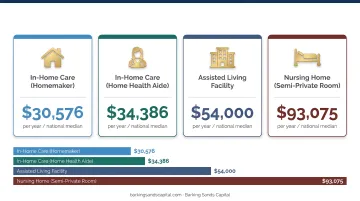
For someone needing three or more years of nursing home care, total out-of-pocket exposure can easily exceed $300,000–$400,000.
Key Factors That Affect the Cost of Senior Care
Understanding what drives costs helps families focus their planning where it matters most. Three factors account for the largest variation: care type, geography, and how care is delivered.
Type and Level of Care Required
Care needs rarely stay static. A senior who starts with 10 hours per week of companion care may progress to assisted living, then memory care, then skilled nursing — sometimes over just a few years. Planning only for the entry point leads to chronic underestimation.
A realistic budget models the full spectrum of likely needs, not just the starting point.
Geographic Location
Geography can shift costs by 30–50% or more. Genworth/CareScout's state-level data shows stark regional differences:
- Minnesota home health aide: $43/hour ($98,384/year)
- Michigan home health aide: $34/hour ($77,792/year)
- Connecticut assisted living: $7,099/month — 41% higher than Michigan's $5,039/month
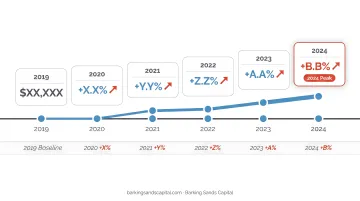
For families in Minnesota and Michigan, costs generally run below coastal averages — but they've risen sharply. Home care and assisted living costs increased nearly 50% from 2019 to 2024, while household income for those 65+ grew only 22% over the same period.
Care Setting and Provider Type
- Home care agencies provide vetted, insured caregivers at a premium — typically $35+/hour
- Direct-hire caregivers cost less but shift background-check, scheduling, and employer-tax responsibilities to the family
- Family caregivers offset paid care costs significantly, though at real personal and sometimes financial cost to the caregiver
Many families blend paid and unpaid care to manage expenses. What starts as a workable arrangement can shift quickly when caregiver burnout sets in or medical complexity grows — making early financial planning for that transition critical.
How Families Pay for Senior Care
Most families end up using a combination of payment sources. Understanding all options before a crisis hits is what separates a manageable plan from a financial emergency.
Personal Savings and Retirement Assets
Personal funds — retirement accounts, pensions, investment income, HSAs, and home sale proceeds — are the most common payment source. The risk is drawing down assets faster than anticipated, which undermines financial security for a surviving spouse or the senior's remaining years.
Senior care costs need to be built into a retirement drawdown strategy from the start — not addressed as a separate problem once a care need surfaces.
Medicare vs. Medicaid: Understanding the Difference
This is the most common and costly misunderstanding in senior care planning. A 2025 Nationwide survey found that 58% of Americans incorrectly believed Medicare would cover long-term care expenses.
Here's the actual breakdown:
| Program | What It Covers | What It Doesn't |
|---|---|---|
| Medicare | Acute medical care; skilled nursing up to 100 days after a 3-day hospital stay | Assisted living, long-term custodial care, ongoing home care |
| Medicaid | Long-term care for those meeting income/asset eligibility requirements | Care for those with assets above eligibility thresholds |
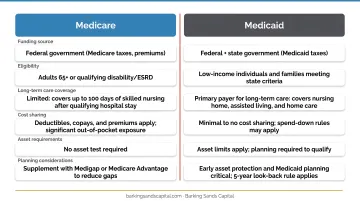
Medicare SNF coverage details (2026): Days 1–20: $0 after Part A deductible; Days 21–100: $217/day copay; Day 101+: full cost.
Medicaid spend-down: To qualify for Medicaid long-term care coverage, individuals must spend down assets to meet state eligibility thresholds. Asset limits vary by state and program type:
- Minnesota Medical Assistance: $3,000 (individual), $6,000 (couple)
- Michigan (LTC-related categories including MA Waiver for Elderly/Disabled): $9,950 for an individual
Certain assets — including a primary residence under specific conditions — may be exempt. Planning with an advisor before reaching those thresholds preserves more options.
Long-Term Care Insurance
Traditional LTC insurance pays a daily or monthly benefit for covered services once a person can no longer perform a specified number of activities of daily living. Premiums vary significantly by age and health at application.
2024 annual premium examples (AALTCI data):
| Age | Single Male | Single Female | Couple |
|---|---|---|---|
| 55 | $950–$2,075 | $1,500–$3,700 | $2,080–$5,025 |
| 65 | $1,700–$3,135 | $2,700–$5,265 | $3,750–$7,150 |
Waiting from 55 to 65 increases premiums by roughly 50%, and nearly half of applicants over 70 are declined due to health.
Hybrid LTC/life insurance policies have largely displaced traditional coverage in the market. In 2022, hybrid policies outsold traditional LTC policies by more than 5-to-1 (154,352 vs. 27,181 policies). If you never need long-term care, your beneficiaries receive a death benefit rather than losing all paid premiums.
Determining whether a traditional or hybrid policy fits a client's overall retirement and estate plan is a core part of Barking Sands Capital's fee-based planning process. Because the firm doesn't earn commissions on insurance sales, the analysis focuses on what actually fits the client's situation.
VA Benefits and Other Government Programs
Veterans may qualify for significant additional benefits:
- Aid and Attendance: Monthly payments added to a VA pension for veterans needing help with daily activities
- VA long-term care services: Can include nursing care, adult day health, assisted living support, skilled home health, and Community Living Centers — availability and copays vary
- PACE (Program of All-Inclusive Care for the Elderly): Available in both Michigan and Minnesota for those 55+, nursing-home eligible, and able to live safely in the community with support
Minnesota also offers the Alternative Care program for low-income seniors not yet Medicaid-eligible, while Michigan's MI Choice Waiver allows Medicaid-eligible adults to receive nursing-facility-level services at home or in the community.
Reverse Mortgages and Home Equity
A HECM (Home Equity Conversion Mortgage) allows homeowners 62+ to convert home equity into cash. For some families, this provides a meaningful funding bridge.
The risks are real, though:
- Interest and fees accumulate over time, reducing equity
- Borrowers must maintain property taxes, insurance, and upkeep
- Heirs may receive little or nothing from the home
Home equity works best as a supplemental funding source when other streams fall short. It's rarely a reliable primary strategy for covering long-term care costs.
How to Build a Senior Care Budget
An accurate budget accounts for one-time costs, recurring expenses, cost escalation over time, and realistic care duration scenarios.
Start With a Needs Assessment, Not a Price
Before researching costs, identify the likely care trajectory:
- Which activities of daily living (ADLs) require assistance now vs. likely future needs?
- What is the current level of medical complexity?
- Are there cognitive health concerns that suggest memory care may be needed?
- What informal caregiver support is realistically available?
Jumping to cost research before answering these questions leads to budgets built around the wrong type of care.
Account for One-Time vs. Recurring Costs
One-time costs:
- Home modifications (grab bars, ramps, stair lifts): $1,000–$20,000+
- Facility move-in or community fees
- Legal documents (power of attorney, advance directives, trusts)
Recurring costs:
- Monthly care fees
- Medications and medical supplies
- Transportation
Over a three-year care period — the average duration — recurring costs compound significantly. Over five or more years (which 20% of today's 65-year-olds will need), total out-of-pocket costs can reach six figures or more.
Plan for Inflation and Cost Escalation
Home care costs rose 7.9% annually over the five years ending in 2024. Nursing home costs rose 25% from 2019 to 2024. Building in an annual cost increase assumption is non-negotiable. LTC insurance policies typically offer 3% or 5% inflation-protection riders — those figures are a reasonable starting benchmark. Flat-line projections will systematically understate what care actually costs by year three or five.
The Four Mistakes That Derail Most Plans
- Planning for only year one — Average LTC duration is 3 years, but 20% need care for more than 5. Budget for the long tail.
- Assuming Medicare covers custodial care — It doesn't. This misconception leaves families financially exposed.
- Waiting too long to purchase LTC insurance — By the time most families think about it, health problems have made premiums unaffordable or coverage unavailable.
- Treating senior care as separate from retirement planning — LTC costs interact directly with tax strategy, Social Security timing, Medicaid eligibility, and estate planning. Siloing them leads to expensive mistakes.
When to Bring In a Financial Planner
The interaction between LTC insurance selection, Medicaid planning, retirement asset drawdown, estate planning, and tax implications is genuinely complex. Self-guided planning frequently misses the connections between these pieces.
These are the areas where coordinated planning pays off:
- LTC insurance selection and when it still makes sense to apply
- Medicaid spend-down strategy and asset protection timing
- Sequencing retirement account withdrawals to preserve eligibility
- Aligning estate documents with the care and financial plan
Barking Sands Capital's InteProcess™ brings legal, insurance, tax, retirement, and financial planning into a single coordinated process. Curtis Hewitt, the firm's advisor specializing in Medicare Planning and Long-Term Care, works with families in Michigan and Minnesota on these scenarios. Contact the team at 952-500-8854 (Minnesota) or 248-687-1040 (Michigan).
Conclusion
Senior care costs span a wide range — from roughly $36,000 per year for part-time home care to over $129,000 for a private nursing home room. Whether a family navigates those costs manageably or reaches a crisis point rarely depends on how much money they have — it depends on when planning starts.
Three things separate families who handle senior care costs well from those who don't:
- Knowing realistic cost ranges before care becomes urgent
- Identifying which payment sources — Medicare, Medicaid, long-term care insurance, personal savings — apply to the situation
- Integrating senior care expenses into a broader retirement and estate plan
Families who do this work early — ideally 10 to 15 years before care is needed — have far more options than those who wait until a health crisis forces the decision. Advisors who specialize in retirement and long-term care planning, like the team at Barking Sands Capital, can help build that plan before the window closes.
Frequently Asked Questions
How much can I have in the bank before I have to pay for care?
Medicaid asset limits vary by state and program type. Michigan's LTC-related categories allow up to $9,950 for an individual; Minnesota Medical Assistance allows $3,000 for an individual and $6,000 for a couple. A primary residence is typically exempt if a spouse or dependent remains in the home. Planning with an advisor before reaching those thresholds can preserve significantly more options.
What should families do when elderly parents have no money?
Medicaid is the primary safety net, supplemented by state programs like Minnesota's Alternative Care and Michigan's MI Choice Waiver, VA benefits for eligible veterans, and family caregiver arrangements. The Eldercare Locator (1-800-677-1116) can help you find local assistance programs.
What is the 40-70 rule for aging parents?
The 40-70 rule suggests families start planning conversations when a parent is around 70 and the adult child is around 40 — while health is still good and decisions can be made thoughtfully. Waiting for a health crisis narrows both options and the capacity to make clear decisions.
Where do most older people who need care receive that care?
The majority receive care at home. According to ACL/HHS data, 65% of today's 65-year-olds who need care will receive it at home for an average of two years, while 37% will receive care in a facility setting. Home-based care is both the most common preference and the most common outcome.
Does Medicare pay for assisted living or nursing home care?
Medicare does not cover assisted living. It covers skilled nursing facility care only for up to 100 days following a qualifying three-day inpatient hospital stay — with a $217/day copay for days 21–100. Long-term custodial care in any setting is not covered; Medicaid and private LTC insurance are the relevant funding sources.
When is the best time to buy long-term care insurance?
Most financial planners recommend purchasing LTC insurance in the mid-50s to early 60s, when premiums are still affordable and applicants are more likely to qualify based on health. Waiting until 65 increases annual premiums by roughly 50%, and insurers decline nearly half of applicants over 70 due to health issues.