

That combination — high income, late start, high debt, high taxes — demands more than a generalist financial advisor. It demands a fiduciary: an advisor legally and ethically required to act in your best interest, not one operating under the weaker "suitability" standard that allows commission-driven recommendations without violating any rules.
This guide covers what makes fiduciary advisors the right choice for physicians, five standout firms serving medical professionals today, and a practical framework for evaluating which advisor fits your career stage and goals.
Key Takeaways
- 71% of medical graduates carry education debt, with a mean load of $212,341 per AAMC's October 2024 data, making financial planning a career-long priority.
- Fiduciary advisors are legally bound to put your interests first — a standard broker-dealers operating under Reg BI do not meet.
- The best physician-focused firms combine fiduciary status, transparent fees, and specific experience with medical career milestones.
- Starting a fiduciary advisory relationship during residency, rather than waiting until attending status, compounds its impact over a 30-year career.
- Barking Sands Capital, SLP Wealth, Brighton Jones, WealthKeel, and Wrenne Financial Planning are among the strongest options available today.
Why Physicians Need a Fiduciary Financial Advisor
The Financial Profile That Creates Real Risk
Most physicians complete residency in their late 20s or early 30s. At that point, they're carrying six-figure student debt while their college peers have had a decade of compound growth in their retirement accounts. The 2024 AAMC median first post-MD year stipend was just $65,100 — barely enough to service the debt, let alone invest.
Then income jumps. Suddenly a physician is earning $300,000–$500,000 and hitting the 37% federal tax bracket (which applies to single filers above $640,600 and married couples above $768,700 for 2026, per the IRS). Without a coordinated tax and retirement strategy in place from day one, that income spike becomes a tax liability rather than a wealth-building event.
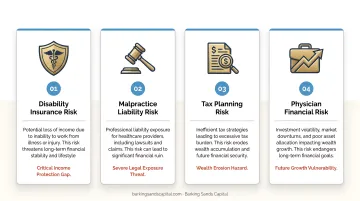
The unique risks that add to this exposure:
- Own-occupation disability insurance (the only type that protects a surgeon's income if they can no longer practice their specialty specifically)
- Malpractice liability : the AMA's 2025 Policy Research Perspective confirms premiums have climbed steadily since 2015, with 68% of medical groups reporting increases since 2022
- Practice ownership complexity : entity structuring, cash-balance plans, and buy-in decisions that generic advisors rarely understand
- Missed planning windows : backdoor Roth contributions, tax-loss harvesting, and PSLF eligibility that disappear if not acted on at the right career stage
Fiduciary vs. Suitability: Why the Distinction Matters
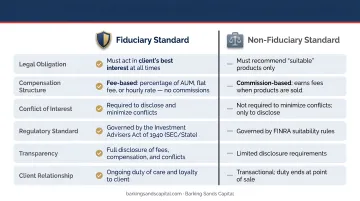
A fiduciary advisor is legally required to act in your best interest at all times. A broker-dealer operating under SEC Regulation Best Interest (Reg BI) only needs to recommend products deemed "suitable" at the moment of sale. Reg BI imposes no ongoing duty to monitor your situation after that recommendation is made.
The practical difference: a commission-based broker can sell you a higher-cost investment product that qualifies as "suitable" and pocket the commission without violating any rules. A fiduciary cannot.
For a physician managing $500,000 or more across a 30–35 year career, even a 0.5% difference in annual advisory costs adds up to tens of thousands of dollars. The fiduciary standard doesn't just protect you from bad advice — it structurally removes the incentive to give it.
Best Fiduciary Financial Advisors for Physicians
The following firms stand out for physician-relevant expertise, transparent fee structures, and the ability to address the full complexity of a doctor's financial life — from residency through retirement.
Barking Sands Capital
Founded in 2004 by J.B. and Kelly L'Esperance, Barking Sands Capital (The L'Esperance Group, LLC) is an independent Registered Investment Advisor headquartered in Minnetonka, Minnesota, with a branch in Troy, Michigan. The team includes advisors holding CFP® and ChFC designations, covering investment management, retirement planning, estate planning, tax planning, Medicare planning, and long-term care planning.
As an independent RIA, the firm cannot be paid commissions on managed accounts — a structural safeguard built into how the business operates, not a policy that can shift. This matters for physicians who have often encountered advisors with product-driven incentives.
Their proprietary InteProcess™ coordinates legal, insurance, tax, retirement, and financial planning professionals as a unified team rather than isolated specialists. For physicians managing multiple complex financial layers simultaneously, that coordination prevents the gaps and conflicting advice that arise when disciplines operate independently. Client assets are held with independent custodians including Schwab, Pershing, and Altruist.
| Aspect | Details |
|---|---|
| Fee Structure | Fee-based, independent RIA; no commissions on managed accounts |
| Key Services | Investment management, retirement analysis, estate planning, tax planning, Medicare & long-term care planning, small business planning |
| Best For | Physicians in Minnesota, Michigan, and the broader Midwest seeking comprehensive, fiduciary-committed planning with coordinated multi-discipline expertise |
SLP Wealth
SLP Wealth is a nationally operating fee-based fiduciary RIA with strong depth in both investment management and student loan planning. The team holds CFP®, ChFC, CFA, and CSLP designations , making it one of the more credentialed physician-focused lineups available. Per their current ADV filing (CRD 325631), ongoing financial planning fees range from $199 to $834 per month, with investment management starting at 0.75% per annum.
Integrating student loan strategy alongside comprehensive financial planning is where SLP Wealth earns its place on this list. For physicians still carrying significant medical school debt mid-career, that combination is rarely available in a single firm.
| Aspect | Details |
|---|---|
| Fee Structure | Monthly flat fee ($199–$834) plus AUM-based investment management fee from 0.75% per annum |
| Key Services | Investment management, student loan planning, retirement savings, tax planning, cash flow management, insurance advice |
| Best For | Residents, fellows, and practicing physicians nationwide navigating significant student debt alongside investment management needs |
Brighton Jones
Brighton Jones is a Seattle-based fee-only fiduciary wealth management firm offering a Personal CFO service model. Physicians get a dedicated advisor coordinating across in-house professionals in taxes, estate planning, retirement, philanthropy, and real estate. Per their ADV (CRD 108601), their Personal CFO annual fee generally ranges from 0.35% to 1.25% of assets, with a minimum annual fee of $10,000.
Brighton Jones has operated as fully fee-only since founding. No advisors hold dual registrations that allow switching between fiduciary and non-fiduciary modes based on the transaction type.
| Aspect | Details |
|---|---|
| Fee Structure | Fee-only; PCFO annual fee 0.35%–1.25% of assets; $10,000 minimum annual fee |
| Key Services | Wealth management, tax advisory, retirement plan advisory, estate planning, philanthropy, real estate advisory |
| Best For | High-net-worth physicians seeking a full-service Personal CFO-style relationship with strong in-house tax and estate capabilities |
WealthKeel
WealthKeel is a physician-only financial planning firm serving physicians, dentists, and veterinarians — primarily those aged 30–50. Their subscription-based model charges a $3,000 one-time plan creation fee plus an ongoing monthly subscription starting at $700. Medical residents and fellows access a reduced monthly rate of $500 during training, recognizing that fiduciary planning shouldn't require attending-level income to access.
Because the firm serves only medical professionals, every planning framework and recommendation is built around physician-specific financial realities, from post-residency income spikes to practice buy-in decisions.
| Aspect | Details |
|---|---|
| Fee Structure | $3,000 one-time plan creation fee + monthly subscription from $700; $500/month reduced rate for residents and fellows |
| Key Services | Investment management, retirement planning, student loan planning, insurance planning, tax planning, financial wellness |
| Best For | Physicians in their 30s–50s wanting a physician-exclusive firm with a structured, subscription-based planning model |
Wrenne Financial Planning
Wrenne Financial Planning is a physician-focused fee-only advisory firm (CRD 173029) serving residents, fellows, and practicing physicians at each career stage. Their ADV filing is direct: "WFP only receives compensation directly from clients. We do not receive compensation from any outside source."
Pricing scales with career stage. The combined services upfront fee runs $750 to $3,000, with ongoing annual fees of $1,200 to $20,000. Standalone student loan planning is available for $500 (single borrower) or $750 (dual household). Discounted rates for residents and fellows make fiduciary planning accessible before attending income arrives.
| Aspect | Details |
|---|---|
| Fee Structure | Upfront fee $750–$3,000; ongoing annual fee $1,200–$20,000; student loan planning $500–$750; discounted rates for residents/fellows |
| Key Services | Investment management, financial planning, student loan planning, tax planning |
| Best For | Residents, fellows, and early-career physicians wanting fiduciary planning that scales affordably from training into practice |
How to Choose the Best Fiduciary Financial Advisor for Your Medical Career
Verify Fiduciary Status and Compensation Model First
Ask every prospective advisor two direct questions:
- "Are you a fiduciary 100% of the time?"
- "Are you fee-only or fee-based?"
Fee-only means no commissions, ever. Fee-based means primarily fee-based but potentially earning some commissions on certain products. Both structures can work, but knowing which applies to your advisor matters before you sign anything. Be particularly cautious of dually-registered advisors who can shift between fiduciary and non-fiduciary modes depending on the transaction type.
Confirm Physician-Specific Expertise
A general financial advisor typically won't be familiar with:
- Own-occupation disability insurance and how it differs from standard policies
- PSLF eligibility windows and income-driven repayment timing
- Practice buy-in structures and entity considerations for private practice owners
- The tax mechanics of a sudden income jump from residency stipend to attending salary
Ask prospective advisors how many physician clients they currently serve and request anonymized examples of physician-specific planning scenarios they have handled.
Evaluate Credentials Rigorously
Look for at least one of these top-tier designations:
- CFP® (Certified Financial Planner) — requires education, a comprehensive examination, 6,000 hours of experience, and ongoing ethics standards
- ChFC (Chartered Financial Consultant) — requires eight courses and examinations plus adherence to The American College Code of Ethics
- CFA (Chartered Financial Analyst) — requires three exams, 4,000 hours of relevant work experience, and CFA Institute membership
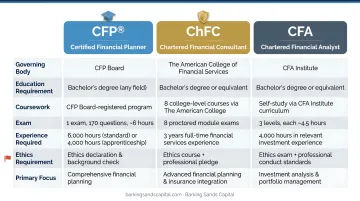
These credentials signal competence and accountability, not just sales ability.
Read the ADV Before Committing
Credentials confirm training. The ADV confirms what's actually happening financially. Every SEC-registered investment advisor must file a Form ADV Part 2A — a public disclosure document listing all fees, compensation structures, and potential conflicts of interest. You can look up any registered firm at adviserinfo.sec.gov. Read this document before signing anything. It will tell you what the advisor charges, how they're compensated, and whether any conflicts of interest exist.
Assess Planning Comprehensiveness
The best advisors for physicians don't just manage a portfolio — they coordinate across legal, tax, insurance, retirement, and estate planning. Ask whether the firm offers in-house capabilities across tax, legal, insurance, and estate planning or routes everything to outside referrals.
Barking Sands Capital's InteProcess™ is one model built around this principle. Rather than sending physicians to separate specialists who may never talk to each other, it integrates five disciplines — legal, insurance, tax, retirement, and financial planning — into a single coordinated team. For physicians, that matters: a tax decision made without input from your estate attorney or disability insurance advisor can create costly blind spots down the road.
Conclusion
For physicians, working with a fiduciary financial advisor isn't optional — it's the minimum acceptable standard given the financial complexity of a medical career. The combination of late start, high debt, high income, and high tax exposure makes uninformed or conflicted financial advice costly over a 30-year horizon.
Start early. Many fiduciary firms offer discounted fee structures specifically for residents and fellows, and the difference between starting a coordinated financial plan at 28 versus 38 compounds significantly by retirement. The right advisor manages investments, yes — but also coordinates tax strategy, disability coverage, debt payoff sequencing, and estate planning as a single integrated plan.
Physicians in Minnesota, Michigan, or across the Midwest can connect with Barking Sands Capital — an independent RIA with over 22 years of experience, CFP® and ChFC designations on the team, and a fee-based structure that prevents commission-driven conflicts by design.
Reach them at 952-500-8854 (Minnesota) or 248-687-1040 (Michigan).
Frequently Asked Questions
Should medical professionals use a fiduciary financial advisor?
Yes. Physicians face a financial profile — high debt, high income, high tax exposure, and specialty-specific insurance needs — that generic advisory relationships regularly fail to address. Working with a non-fiduciary exposes you to advice that may prioritize the advisor's compensation over your financial outcomes, which is a risk no physician's financial plan can absorb.
What is the difference between a fiduciary and a non-fiduciary financial advisor?
A fiduciary is legally required to act in your best interest at all times. A non-fiduciary broker-dealer under SEC Regulation Best Interest only needs to recommend "suitable" investments at the time of recommendation — a lower bar that permits commission-driven products and imposes no ongoing duty to monitor your situation.
What is a typical fee for a fiduciary financial advisor?
AUM-based fees typically run around 1.00% annually for a $1M portfolio, according to Kitces Research. Subscription and flat-fee models vary widely — the firms profiled above range from $199 to $834 per month. Always review an advisor's ADV Part 2A for precise fee disclosures before engaging.
When should a physician start working with a financial advisor?
During residency, if possible. Establishing a loan repayment strategy and starting retirement contributions early can meaningfully compound over a 30-year career. Several fiduciary firms — including WealthKeel and Wrenne — offer reduced fees specifically for residents and fellows.
What net worth do most physicians retire with?
According to Medscape's 2024 Physician Wealth Report, 60% of physicians had a net worth above $1 million in 2023, and Medscape's 2026 report found 50% of male physicians and 37% of female physicians at $2M or more. Outcomes vary significantly by specialty, practice type, and whether the physician worked with a fiduciary advisor throughout their career.