
According to Morningstar research, nearly 70% of failed retirement portfolios experienced investment losses within the first five years. The choice of who manages your money during that window matters enormously.
This guide covers what an investment management firm actually does in a retirement context, six specific factors to evaluate before hiring one, and the red flags that should end a conversation before it goes any further.
Key Takeaways
- Investment management firms in retirement focus on income generation, sustainable distributions, and protecting what you've built—not just growth
- Fiduciary advisors are legally required to act in your interest—not just recommend "suitable" products
- Six factors matter most: fiduciary status, credentials, retirement-specific experience, integrated services, personalization, and firm stability
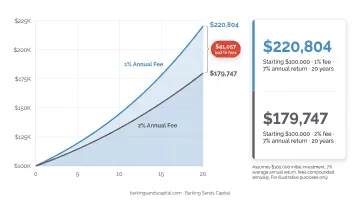
- Even a 1% annual fee difference on $100,000 erases over $55,000 in value over 20 years
- Independent RIAs that integrate tax, legal, insurance, and estate planning alongside investments deliver more cohesive retirement outcomes
What Does an Investment Management Firm Do for Retirement?
FINRA defines a registered investment adviser as an individual or company that provides investment advice to clients for a fee. That definition covers a wide range, so the distinction that matters for retirement clients is what they do ongoing—not just at the moment of sale.
Brokers typically provide transactional services. Investment advisers provide continuous portfolio management, monitoring, and discretionary account oversight. For retirees drawing income from a portfolio, that ongoing relationship is the whole point. That relationship only delivers value if the firm actually offers the right services for your stage of life.
Core Services a Retirement-Focused Firm Should Offer
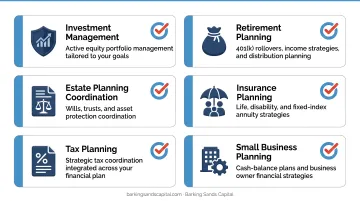
A firm serving retirement clients should go well beyond picking stocks. Look for:
- Portfolio construction and rebalancing aligned with your withdrawal timeline
- Retirement income planning, including withdrawal sequencing and Social Security timing
- Tax-efficient investing, such as Roth conversions and asset location strategies
- RMD management to avoid penalties and coordinate with other income sources
- Estate planning coordination with attorneys and other specialists
- Risk management calibrated for your specific stage of retirement
Why Integrated Planning Matters
Retirement income flows from multiple sources: Social Security, RMDs, portfolio withdrawals, pensions, and sometimes part-time work. Each stream has different tax treatment, timing rules, and interaction effects.
A firm that manages only your investments without coordinating these streams risks leaving income gaps and unnecessary tax drag. Barking Sands Capital's InteProcess™ addresses this by connecting legal, insurance, tax, retirement, and financial planning within a single coordinated framework—so no discipline operates in isolation.
Six Factors to Evaluate When Choosing a Retirement Investment Firm
The evaluation criteria for retirement investors are more demanding than for someone in their 30s building wealth. The time horizon has shifted, the cost of error is higher, and the complexity of income coordination requires more from your advisory team.
Fiduciary Status and Fee Transparency
The fiduciary standard requires an investment adviser to act in your best interest at all times. The SEC's fiduciary interpretation establishes this as a duty of care and a duty of loyalty—and critically, it cannot be waived by contract language.
Broker-dealers operate under a different standard. They must recommend "suitable" products, but suitability isn't the same as best interest. For retirees with no runway to recover from bad advice, that gap has real financial consequences.
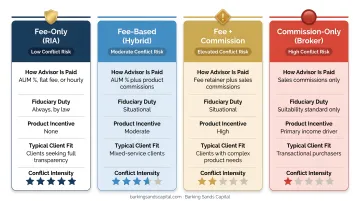
Common fee structures to understand:
| Structure | How You Pay | Conflict Risk |
|---|---|---|
| AUM percentage | % of assets annually | Low if disclosed |
| Fee-only | Direct client payment only | Lowest |
| Fee-based | Fees + possible commissions | Moderate |
| Commission-based | Per transaction or product sale | Highest |
Kitces Research reports that 86% of advisory firms use AUM fees as their primary model, with typical rates of 1.00%–1.20% for portfolios under $1M. Always ask for the total all-in cost, including underlying fund expenses.
Barking Sands Capital operates as a fee-based independent RIA—their compensation comes from client fees, not product commissions, which eliminates the incentive to recommend what pays best rather than what fits best.
Credentials and Certifications
Not all credentials are equally relevant for retirement planning. These four are the most meaningful:
- CFP® (Certified Financial Planner): Requires a 170-question exam, 4,000–6,000 hours of experience, and ongoing ethics requirements
- ChFC (Chartered Financial Consultant): Eight-course curriculum with three years of required business experience; covers advanced planning scenarios
- CFA (Chartered Financial Analyst): Rigorous investment analysis focus; 4,000+ hours of qualifying work experience required
- RIA registration: Regulated by the SEC or state securities regulator; requires Form ADV disclosure on services, fees, and conflicts
Before hiring anyone, verify credentials using:
- FINRA BrokerCheck — employment history, licenses, disciplinary actions
- SEC's IAPD database — RIA registration and Form ADV details
- CFP Board's verification tool — CFP® certification status and disciplinary history
Barking Sands Capital's team includes JB L'Esperance (ChFC), Andrea Cervena (CFP®), and advisor Curtis Hewitt with Life/Health licenses and Series 6 and 63 registrations—providing specialized coverage across investment management, comprehensive planning, and Medicare/long-term care.
Retirement-Specific Experience and Track Record
General investment management experience doesn't automatically translate to retirement planning expertise. Ask candidates directly about their experience with:
- Sequence-of-returns risk: Early losses can permanently reduce portfolio longevity. Morningstar found that a positive return in just the first year of retirement cut the probability of portfolio failure by 50%.
- RMD strategy: Timing and coordination with other income sources affects your tax bracket each year
- Social Security optimization: Delaying from age 62 to 70 can increase monthly benefits by up to 76%
- Healthcare cost integration: Medicare timing, IRMAA surcharges, and long-term care funding
Ask firms for examples of how they've helped clients through market downturns while maintaining income distributions. A track record across volatile periods is more meaningful than performance in a bull market.
Breadth of Integrated Services
Retirement planning decisions don't exist in isolation. A Roth conversion affects your tax bracket, which then triggers IRMAA surcharges on Medicare premiums and changes your net retirement income. An advisor managing only your portfolio can't see that chain of consequences.
Ask prospective firms:
- Do you have specialists in tax planning, Medicare, long-term care, and estate planning—or do you refer out for everything?
- How do your investment decisions coordinate with my tax and legal situation?
- Will I work with one advisor or multiple specialists depending on the issue?
Barking Sands Capital's InteProcess™ coordinates designated professionals across legal, insurance, tax, retirement, and financial planning as a unified team—rather than referring clients to unrelated outside professionals with no shared context.
Personalization and Communication
Two retirees with $800,000 can have completely different income needs, legacy goals, risk tolerances, and spending patterns. A firm that pushes everyone into the same model portfolio isn't equipped for that complexity.
During your initial conversations, ask:
- How do you customize portfolios for clients at different stages of retirement?
- How often are portfolios reviewed, and what triggers an unscheduled review?
- How do you communicate with clients during market downturns?
- Will I have a dedicated advisor or rotate through staff?
Active investment management with hand-picked equity selections—rather than a standardized platform—is one way firms demonstrate genuine personalization. Regular touchpoints also matter: monthly investment outlook letters and video market updates keep clients informed without requiring them to call every time the market moves.
Firm Stability and Succession Planning
A retiree working with an advisor over a 20–30 year retirement horizon needs to know what happens if that advisor retires, departs, or becomes unavailable.
This is a legitimate question to ask directly: What is your succession plan? If my primary advisor leaves, what happens to my account, my financial history, and my ongoing income distributions?
A well-structured firm has documented answers. A multi-member team structure—where a dedicated Client Relationship Manager holds 20+ years of financial services experience—means client continuity isn't dependent on any single individual.
Red Flags to Watch Out For
Some warning signs appear during the sales process. Others are structural problems with the firm itself.
Behavioral red flags during conversations:
- Pressure to decide quickly or sign before reviewing documents
- Vague or evasive answers when you ask how they're compensated
- Reluctance to confirm fiduciary status in writing
- Guarantees of specific returns or "risk-free" investment opportunities
- Disciplinary history on FINRA BrokerCheck that they haven't disclosed
Structural red flags at the firm level:
- Only offers proprietary products with no independent alternatives
- No credentials specific to retirement income planning
- Cannot provide references from retired clients in comparable situations
- No succession plan in place for advisor departures
These structural problems matter more than they might seem at first, especially when fees are involved. The SEC has documented how seemingly small cost differences erode retirement savings over time: a $100,000 portfolio growing at 6% annually reaches $320,714 over 20 years. At 5% (after a 1% higher fee), it reaches $265,330. That 1% fee difference costs more than $55,000 over two decades, before accounting for the additional drag on a larger portfolio.
How Barking Sands Capital Can Help
Barking Sands Capital (The L'Esperance Group, LLC) is an independent, fee-based Registered Investment Advisor founded in 2004 by JB and Kelly L'Esperance. Both founders left larger financial organizations because they disagreed with the culture of pushing products that didn't fit client needs.
Their answer was a firm built entirely on fee-based, client-first advisory — where compensation comes from clients, not from what gets sold to them.
The firm serves retirement clients across Minnesota, Michigan, and the broader Midwest, with offices in Minnetonka, Minnesota and Troy, Michigan.
Here's how the firm maps to the six evaluation factors covered in this guide:
- Fiduciary and fee structure — Independent RIA; compensation comes from client fees only, with no product commissions
- Credentials — Andrea Cervena holds the CFP® designation; JB L'Esperance holds the ChFC; Life/Health insurance licenses held across both Michigan and Minnesota
- Retirement experience — Active investment management across multiple market cycles, including 401(k) rollovers, asset distribution strategies, and Roth IRA conversions
- Integrated services — The proprietary InteProcess™ coordinates legal, insurance, tax, retirement, and financial planning, with each area handled by a dedicated specialist
- Medicare and long-term care — Advisor Curtis Hewitt specializes in Medicare planning and IRMAA strategies that connect directly to retirement income and tax planning
- Asset custody — Client assets held at independent custodians (Altruist, Pershing, Schwab, TD Ameritrade), so no single entity controls both your advice and your money
To discuss your retirement investment management needs, contact Barking Sands Capital directly:
- Minnesota: 952-500-8854
- Michigan: 248-687-1040
- Email: jb@barkingsandscapital.com
Conclusion
The right investment management firm for retirement fits your specific situation—your income needs, your timeline, your legacy goals, and the reality of coordinating Social Security, taxes, distributions, and estate planning all at once. Brand name and advertised fees tell you very little about whether a firm can actually do that work well.
Retirement is not a phase where a poor advisory relationship corrects itself over time. Ask the hard questions—about fiduciary status, fee transparency, succession planning, and retirement-specific experience—before you sign anything. A firm that answers those questions clearly and specifically is one worth a closer look.
Frequently Asked Questions
Which investment firm is best for retirees?
There is no single best firm for every retiree. What matters is whether the firm operates as a fiduciary, holds relevant credentials in retirement income planning, coordinates planning across tax and legal disciplines, and provides personalized service rather than pushing clients into standardized model portfolios.
What is the difference between a fiduciary and a non-fiduciary investment advisor?
Fiduciaries are legally required to act in your best interest at all times under the Investment Advisers Act. Non-fiduciaries—such as broker-dealers—must only recommend "suitable" products under FINRA Rule 2111 and Regulation Best Interest. That distinction directly affects whether the advice you receive is optimized for your interests or the advisor's compensation.
What fees should I expect to pay an investment management firm?
Most retirement-focused firms charge AUM-based fees, typically 1.00%–1.20% annually for portfolios under $1M and 0.80%–1.00% for larger accounts, per industry benchmarks from Kitces Research and Cerulli Associates. Fee-only and fee-based RIAs are generally more transparent about total costs than commission-driven models.
How do I verify an investment manager's credentials before hiring them?
Use FINRA BrokerCheck for broker history and disciplinary records, the SEC's IAPD database for RIA registration and Form ADV details, and the CFP Board's verification tool for CFP® certification status. All three are free and publicly accessible.
Should I use a large national firm or an independent advisor for retirement planning?
Large firms offer name recognition but often push proprietary products and may lack the personalization that retirement complexity demands. Independent RIAs typically provide more customized service, greater fee transparency, and stronger alignment between advisor incentives and client outcomes.
What questions should I ask an investment management firm before hiring them for retirement?
Ask these before signing anything:
- Are you a fiduciary, and will you confirm that in writing?
- How are you compensated — AUM fee, flat fee, or commission?
- What retirement-specific experience do you have with RMDs, distribution planning, and Social Security?
- What happens if my primary advisor leaves the firm?
- How often will you review my portfolio, and how do you communicate during market downturns?