
This article clarifies what estate planning actually covers, how a living trust fits into that picture, where the two overlap and where they don't, and how to determine what your situation actually requires.
Key Takeaways
- Estate planning is the full process — legal, financial, and healthcare directives combined — not a single document
- A living trust avoids probate and protects privacy, but cannot name a guardian for minor children or replace a will
- An unfunded trust (assets never retitled into it) provides almost no protection at all
- Most people with moderate-to-complex estates need both a will and a living trust, plus powers of attorney and healthcare directives
- Estate planning touches your taxes, retirement accounts, and insurance — coordinate legal and financial planning together, not separately
What Is Estate Planning?
Estate planning is the ongoing process of organizing your financial, legal, and personal affairs so your assets are managed and distributed according to your wishes — during your lifetime and after death. It's a process, not a single document or one-time event.
The Core Documents
A complete estate plan typically includes:
- Last will and testament — directs asset distribution and names guardians for minor children
- Revocable living trust — manages and transfers assets outside of probate (if applicable)
- Durable financial power of attorney — authorizes someone to manage financial decisions if you're incapacitated
- Healthcare power of attorney — designates someone to make medical decisions on your behalf
- Advance directive / living will — documents your wishes for end-of-life medical care
- Beneficiary designations — on retirement accounts, life insurance, and transfer-on-death accounts
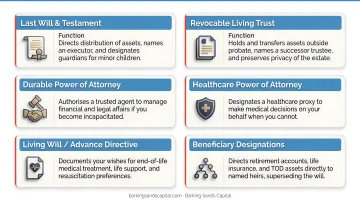
Each document serves a distinct purpose. Missing any one of them creates a gap that the others cannot fill.
More Than Just Asset Distribution
Estate planning also addresses:
- Naming guardians for minor children (only possible in a will)
- Planning for incapacity — not just death
- Minimizing estate or inheritance taxes
- Coordinating beneficiary designations across retirement accounts and life insurance policies
- Business succession planning for small business owners
Despite how essential these decisions are, the 2025 Caring.com Wills and Estate Planning Study found that only 24% of American adults have a will — meaning the vast majority of families are leaving critical decisions to chance.
Who Needs a Full Estate Plan?
Nearly everyone benefits from estate planning, but a comprehensive plan becomes especially critical for:
- Parents of minor children — guardianship can only be named in a will
- Business owners who need succession planning coordinated across legal and financial decisions
- Anyone with real estate in multiple states, where separate probate proceedings can apply in each
- Blended families where assets may not flow as intended without clear legal documents
- People with significant retirement accounts or life insurance whose beneficiary designations must align with the broader plan
This is also where financial planning and estate planning overlap most directly. Barking Sands Capital's proprietary InteProcess™ coordinates legal, insurance, tax, retirement, and financial planning as one unified strategy — because decisions made in one area almost always affect the others.
What Is a Living Trust?
A living trust (formally called a revocable living trust) is a legal arrangement in which you transfer ownership of your assets to a trust during your lifetime. You typically serve as your own trustee while you're alive and capable, naming a successor trustee to take over after your death or incapacity.
The defining feature: assets held in the trust pass directly to beneficiaries without going through probate court.
Two Primary Advantages
- Probate avoidance: Assets transfer to heirs without court involvement, saving time and cost. Probate can take months to more than a year depending on state law, estate complexity, and whether a federal estate tax return is required.
- Privacy: A will becomes public record once it enters probate. A living trust does not — a meaningful distinction for families who want asset transfers kept private.
What a Living Trust Cannot Do
A revocable living trust has real limits — and misunderstanding them is one of the most common estate planning mistakes:
- Cannot name a guardian for minor children — only a will can do this
- Does not cover assets that were never retitled into it — the "unfunded trust" problem is surprisingly common and leaves those assets exposed to probate anyway
- Does not reduce or eliminate estate taxes — because you retain control of a revocable trust, those assets are still considered part of your taxable estate, as the American Bar Association confirms
- Does not protect assets from creditors during your lifetime
Revocable vs. Irrevocable Trusts
A revocable living trust can be changed or dissolved at any time. You maintain full control, but that flexibility comes with a tradeoff: the assets remain yours for tax and creditor purposes, which is why the limitations above apply.
For those with tax or creditor concerns, an irrevocable trust takes a different approach. It generally cannot be changed after it's created, but in exchange for giving up control, it may offer greater estate tax reduction and asset protection benefits — though the specifics depend on the trust's design and applicable state law.
Who Benefits Most from a Living Trust?
A living trust adds the most value for:
- Individuals who own real estate, particularly in multiple states (avoiding separate probate proceedings in each state)
- People who want a successor trustee to step in seamlessly if they become incapacitated
- Those with significant privacy concerns about public probate records
- Families who want to simplify and accelerate the transfer process for heirs
Estate Planning vs. Living Trust: Key Differences
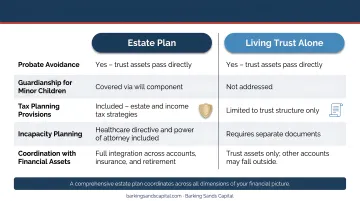
The clearest way to understand the relationship: estate planning is the whole; a living trust is one part. A living trust without a will, power of attorney, and healthcare directive leaves serious gaps. Here's how they compare across five dimensions:
| Factor | Estate Plan (Full) | Living Trust Alone |
|---|---|---|
| Scope | Covers all assets, relationships, healthcare, and incapacity planning | Only governs assets retitled into the trust |
| Probate | Will goes through probate; trust assets bypass it | Trust assets avoid probate; unfunded assets do not |
| Guardianship | Will can name a guardian for minor children | Cannot name a guardian — at all |
| Incapacity | Power of attorney handles financial and medical decisions outside the trust | Successor trustee manages trust assets only |
| Privacy | Wills are public record; POA and healthcare docs are private | Trust is private; no will means no guardian designation |
The Pour-Over Will
Most estate planning attorneys recommend using a living trust alongside a pour-over will — a will that catches any assets not transferred into the trust during your lifetime and directs them into the trust at death. The ABA notes that a living trust rarely avoids probate entirely on its own, and a simple pour-over will is typically needed to capture any remaining assets. Those assets may still go through probate before flowing into the trust, but they ultimately distribute according to the trust's terms.
Cost and Complexity
A living trust costs more to set up than a basic will, but can reduce probate-related costs and delays for heirs. A full estate plan — including a will, trust, powers of attorney, and healthcare directives — has the highest upfront investment but provides the broadest protection.
Costs vary depending on several factors:
- Number and type of documents required
- Whether a trust is used and needs to be funded
- Complexity of retitling assets across accounts and property
- Business interests or ownership structures
- Real estate held in multiple states
Every situation is different, so cost comparisons are most useful when evaluated against your specific circumstances — not general estimates.
When Is a Living Trust Enough — and When Do You Need a Full Estate Plan?
A Living Trust May Suffice If:
- You're single with no dependents
- Your assets are straightforward and held in one state
- You have no complex tax concerns or business interests
- You supplement the trust with a pour-over will and basic powers of attorney
A Full Estate Plan Is Strongly Recommended If:
- You have minor children — guardianship requires a will
- You own a business with succession concerns
- You have retirement accounts or life insurance with beneficiary designations that need to align with your estate plan
- You own property in multiple states
- You have a blended family, a dependent with special needs, or other complex family dynamics
The Most Common Mistake
Setting up a living trust and stopping there. If the trust is never funded — meaning assets are never retitled into it — or if a will, power of attorney, and healthcare directive are never created, the plan has gaps that only surface during a crisis.
Those gaps can also develop over time, even in a well-built plan. Review your documents after any of these life events:
- Marriage or divorce
- Birth of a child
- Significant asset changes
- A move to a new state
A plan that was accurate five years ago may no longer match your wishes — revisiting it proactively is far easier than correcting it under pressure.
Conclusion
A living trust is a valuable planning tool, and for many people it belongs in their estate plan. On its own, though, it doesn't cover everything.
Most families need a will (or pour-over will), a living trust if appropriate for their situation, durable financial and healthcare powers of attorney, and advance directives — all coordinated with beneficiary designations and broader financial planning decisions.
Because estate planning decisions directly affect your retirement accounts, tax strategy, life insurance, and asset management, they're most effective when built collaboratively. Barking Sands Capital works alongside qualified estate planning attorneys through its InteProcess™ framework, so your legal documents and financial plan operate as one cohesive strategy.
If you'd like to explore what a comprehensive, coordinated plan looks like for your specific situation, connect with the Barking Sands Capital team in Minnetonka, Minnesota or Troy, Michigan.
Frequently Asked Questions
What is the difference between a trust and an estate plan?
An estate plan is the complete set of legal and financial documents governing your assets, healthcare decisions, and family wishes — including a will, powers of attorney, healthcare directives, and beneficiary designations. A trust is one specific legal tool within that plan, used to manage and transfer assets while typically avoiding probate.
What is the best way to leave your house to your children in your will?
You can name your children as beneficiaries in your will, though the home will go through probate before transferring. Alternatively, placing the home in a living trust lets it pass directly without court involvement, though each approach carries different legal and tax implications worth confirming with an attorney.
Does a living trust replace a will?
No. Most estate planning attorneys recommend having both. A pour-over will works alongside a living trust to capture any assets not retitled into the trust, and handles matters a trust cannot address — including naming a guardian for minor children.
What are the disadvantages of a living trust?
A revocable living trust costs more to establish than a basic will, requires ongoing maintenance as assets must be retitled into it, does not protect assets from creditors while you're alive, and does not reduce estate taxes.
Do I need a living trust if I already have beneficiary designations on my accounts?
Beneficiary designations on retirement accounts and life insurance bypass probate, but only for those specific assets. Real estate, individually titled bank accounts, and personal property without a POD or TOD designation still require a will or trust to transfer properly.
How does estate planning connect to retirement and financial planning?
Estate planning decisions have direct tax and financial consequences: how retirement accounts are titled, who is named as beneficiary, and how life insurance is structured all interact. Coordinating these choices with both an estate planning attorney and a financial advisor prevents gaps that can cost your heirs significantly.