Introduction
Picture a business owner who spent 30 years building a company from scratch — loyal customers, a trusted team, real enterprise value. Then a health scare forces an unexpected exit. No buy/sell agreement. No named successor. No plan for what happens next.
The result? A forced sale at a fraction of what the business was worth, family conflict over the proceeds, and a retirement that looks nothing like what was planned.
This scenario plays out constantly. According to a 2024 EIX analysis of University of Minnesota Extension research, only 21.6% of business owners had created or updated a written succession plan in the prior three years.
For most of those owners, the business represents 80% to 90% of their personal net worth, according to Exit Planning Institute data.
That level of concentration means succession planning ranks among the highest-stakes financial decisions a business owner faces — yet it's the one most often put off indefinitely.
This guide covers what succession planning involves, which risks it protects against, how to choose a transition path, and the five steps to build a plan that holds up.
Key Takeaways
- A succession plan protects business value whether the transition is planned or forced
- Roughly 50% of owner exits are involuntary, triggered by death, disability, divorce, distress, or disagreement
- Multiple exit paths exist — the right one depends on your goals, timeline, and how buyer-ready the business is
- Coordinating financial, estate, and legal planning early prevents gaps that erode business value at the moment of transition
- Starting early expands your options — delays narrow them and raise costs
What Is Succession Planning for a Business Owner?
Business succession planning is the strategic process of deciding who will take over ownership and leadership of a business — and legally, financially, and operationally preparing for that handoff.
The process evolves continuously — as your business grows, your family situation changes, and tax laws shift. A plan drafted today will look different in five years, and that's expected.
What a Succession Plan Actually Covers
Most owners think of succession planning as picking a successor. That's one piece. A complete plan addresses:
- Business valuation — establishing what the business is actually worth
- Successor identification and development — preparing whoever will take over
- Ownership transfer structure — the legal and tax mechanics of the handoff
- Buy/sell agreements and funding — ensuring liquidity when the transition is triggered
- Estate planning integration — coordinating the business transfer with personal wealth and inheritance goals
- The owner's post-transition finances — confirming retirement is actually funded
These six elements together reveal an important distinction: succession planning is broader than an exit strategy. An exit strategy defines how an owner leaves. Succession planning prepares the business, the successor, and the owner's finances for any ownership transition — including unplanned ones.
Why So Few Owners Have a Plan
Gallup's 2025 Pathways to Wealth Survey found that one-third of business owners had no long-term plan or were unsure about their business's future. Common reasons: too busy, too early, not sure where to start.
Waiting shrinks every option available. Valuation improvements, leadership development, and tax structures all require years to implement effectively — not months. Advisors generally recommend starting the process at least five to ten years before any anticipated transition, precisely because so many of the most valuable moves are unavailable to owners who wait.
The 5 D's Every Business Owner Needs to Plan For
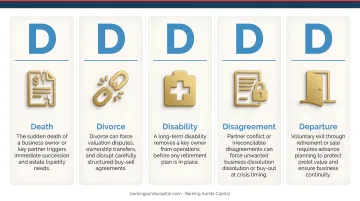
Most succession planning conversations focus on retirement — the planned, orderly exit. But the Exit Planning Institute estimates that roughly 50% of business exits are involuntary, triggered by one of five events known as the 5 D's.
Death, Disability, Divorce, Distress, and Disagreement
| The "D" | How It Disrupts an Unprepared Business |
|---|---|
| Death | Heirs inherit ownership without liquidity or operational knowledge; business may need to be sold quickly at a steep discount |
| Disability | Key decision-making disappears without a designated successor; operations stall |
| Divorce | Ownership interests can become marital property subject to forced sale or division |
| Distress | Financial pressure compresses options; a distressed sale rarely reflects true business value |
| Disagreement | Co-owner disputes can deadlock operations and trigger expensive litigation |
A business owner who plans only for a comfortable retirement exit is unprotected against all five. Protecting against them requires infrastructure that most owners don't build until it's too late: a funded buy/sell agreement, key-person insurance, and a designated successor with documented authority. These tools serve one purpose — keeping the business intact when circumstances force an exit on someone else's timeline.
That's why succession planning belongs on the agenda now, not when retirement starts feeling real. The 5 D's don't wait for a convenient moment.
Succession Planning Options: Choosing the Right Path
One of the first decisions is choosing a succession path. Many owners delay planning because the options feel overwhelming — but they're manageable once you see the full menu laid out clearly.
Internal Succession Options
Family ownership transfer passes leadership and ownership to the next generation. This path requires estate planning integration to manage gift and estate taxes, and honest assessment of whether the family member is operationally ready. Gallup found 26% of owners plan to give the business to a family member.
Management buyout (MBO) involves the existing management team purchasing the business. This preserves continuity and rewards loyalty, but requires careful structuring to manage conflicts of interest when negotiating price and terms with people who work for you.
Employee Stock Ownership Plan (ESOP) uses a company-funded trust to transfer ownership to employees over time. The National Center for Employee Ownership reports 6,098 privately held ESOPs as of 2023. ESOPs carry meaningful tax advantages but are complex and expensive to structure — they're not right for every business.
External Succession Options
Sale to a strategic buyer — a competitor or company seeking market position, customers, or capabilities — can command a premium, but requires clean financials and a business that can run without the owner.
Sale to a financial buyer (private equity or family office) focuses on cash flow and investment return. These transactions often involve the selling owner staying on in some capacity post-sale, which suits some owners and doesn't suit others.
Hybrid and Staged Approaches
Not every transition needs to be a clean break. Two common approaches:
- Minority recapitalization: bringing in outside capital while retaining control, which provides liquidity without a full exit
- Staged transition: delegating operations first, then transferring ownership gradually as the successor demonstrates readiness
Staged transitions are particularly useful when a successor is strong but not yet seasoned — they earn ownership incrementally as they prove it.
The 5 Steps of Succession Planning for Business Owners
Most successful exits follow a structured process that spans years. Starting early is what creates options — for pricing, taxes, timing, and choosing the right successor. Here's the roadmap.
Step 1: Build Your Advisory Team
Succession planning crosses business operations, legal structure, tax law, estate planning, and personal wealth management. No single professional handles all of it well.
A core advisory team typically includes:
- Corporate/estate planning attorney — drafts buy/sell agreements, trust structures, and ownership transfer documents
- CPA — models tax implications across different transaction structures
- Business valuation expert — provides an objective, defensible value for planning and negotiation
- Financial advisor — coordinates the team around the owner's personal financial goals
The financial advisor's role is to serve as the integrating voice across all these disciplines — making sure legal, tax, and estate decisions align with the owner's personal financial picture. A fee-based advisor without commission incentives is particularly well-suited here, since their recommendations aren't shaped by product sales. Barking Sands Capital's JB L'Esperance, a Chartered Financial Consultant (ChFC) specializing in estate and small business planning, works in exactly this coordinating capacity.
Step 2: Determine the Value of Your Business
An objective business valuation is foundational to everything else in the plan. It shapes pricing, funding strategy, tax planning, and successor selection.
Professional valuations use three primary approaches:
- Income approach — values the business based on its expected future earnings
- Market approach — compares the business to similar companies that have sold
- Asset-based approach — focuses on the net value of business assets
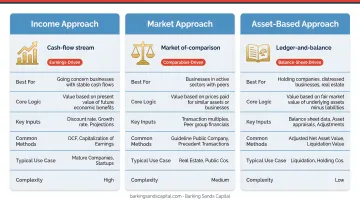
Most owners have an intuitive sense of what their business is worth, but that number is rarely tested against these methodologies. The Exit Planning Institute notes that only 20% to 30% of businesses that go to market actually result in a completed sale — often because sellers and buyers can't agree on value. An independent valuation surfaces that mismatch early, when there's still time to address it.
Step 3: Identify and Prepare Your Successor
Who takes over shapes every other element of the plan. Whether the successor is a family member, key employee, management team, or outside buyer, they need time to prepare — and so does the business.
Key preparation steps:
- Formalize the successor's expanded role with clear milestones
- Build mentorship and cross-training into day-to-day operations
- Document processes and institutional knowledge that currently live in the owner's head
- Reduce key-person dependency so the business can demonstrate value without the current owner
A business where everything runs through one person is worth significantly less to an outside buyer than one that operates independently. That reduction in key-person risk matters for internal transitions too — it signals that the business is built to last.
Step 4: Formalize the Legal and Financial Structure
The buy/sell agreement is the backbone of most succession plans. It defines:
- Triggering events (retirement, death, disability, divorce)
- How the business will be valued at the time of the trigger
- Payment terms and timeline
Funding mechanisms for the buy/sell agreement include:
- Life insurance — most common for closely held businesses; provides immediate liquidity at death without requiring surviving owners or heirs to scramble for cash
- Installment notes — buyer pays over time from business cash flow; transfers risk to the seller
- Sinking funds — reserves accumulated in advance; simpler but can fall short for sudden triggering events
- SBA or commercial loans — viable for qualifying transactions but add debt to the acquiring entity
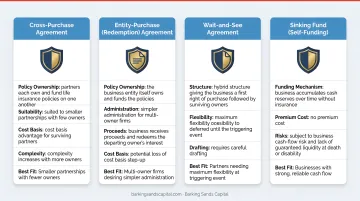
One critical 2024 development: in Connelly v. United States, the Supreme Court held that corporate-owned life insurance proceeds used to redeem shares must be included in corporate value for estate tax purposes — and the redemption obligation doesn't offset them. Entity-redemption buy/sell structures funded with life insurance need review in light of this ruling.
Legal documents and funding mechanisms must also align with estate planning documents. Conflicts between a buy/sell agreement and a will or trust can produce expensive disputes at exactly the moment families are least equipped to handle them.
Step 5: Review and Update the Plan Regularly
A succession plan filed away and forgotten can become dangerously outdated within a few years. Business values change. Family dynamics shift. Tax laws evolve. Successors leave.
At minimum, review the plan:
- Annually — confirm that funding mechanisms (especially insurance coverage amounts) still reflect current business value
- After major business changes — new partners, significant revenue shifts, acquisitions
- After major personal changes — marriage, divorce, death in the family, health events
The Connelly decision is a good example of why periodic review matters. A buy/sell structure that was properly designed three years ago may carry unintended tax exposure today.
Integrating Financial and Estate Planning Into Your Succession Plan
For most business owners, succession planning and personal financial planning are the same conversation. When 80% to 90% of your net worth sits inside your business, the question isn't just "who takes over?" — it's "will the transition actually fund my retirement?"
The Personal Retirement Question
Before finalizing a succession path, model the numbers: will the expected proceeds — whether a sale price, buyout payments, or gradually transferred equity — be sufficient to sustain your retirement at the lifestyle you expect? If the answer is uncertain, that's a signal to either improve business value before transitioning or extend your timeline.
That requires coordinating your business succession plan with your personal financial plan — two conversations that too often happen in separate rooms.
Barking Sands Capital's proprietary InteProcess™ is built for exactly this challenge. Rather than treating legal, insurance, tax, retirement, and financial planning as separate engagements, it brings designated professionals together around the owner's goals, working in coordination rather than isolation.
Estate Planning Dimensions
The estate planning layer of a succession plan addresses several distinct questions:
- Incapacity: Does your legal structure protect business value if you become unable to make decisions?
- Inheritance equalization: If one child works in the business and another doesn't, how do you distribute fairly without forcing a sale?
- Tax minimization: Entity structure, trust planning, and transaction timing can significantly affect estate and income taxes
- Governance: Documented decision-making structures prevent family disputes from paralyzing operations
These decisions should be modeled with a CPA and estate attorney well before a planned transition — ideally two to three years out, when there's still time to implement structures that need time to take full effect.
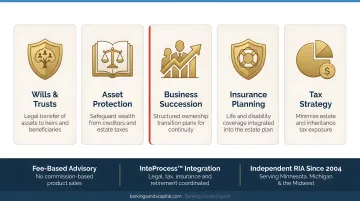
Insurance as Succession Infrastructure
Three insurance categories are directly relevant to succession planning:
- Key-person life insurance protects the business's value if a critical owner or employee becomes unable to work
- Buy/sell funding insurance provides the liquidity for surviving partners or heirs to complete the ownership transfer without a distressed sale
- Disability coverage protects the owner's income during the gap between when they can no longer work and when the formal transition is complete
Because Barking Sands Capital holds life and disability insurance licenses in both Minnesota and Michigan, and operates on a fee-based model without commission incentives, they can evaluate coverage levels based entirely on what fits the client's situation.
Frequently Asked Questions
What is a succession plan for a business owner?
A business succession plan is a documented strategy for transferring ownership and leadership — addressing who takes over, how ownership transfers, when the transition occurs, and how it's legally and financially structured. It protects the owner, heirs, and the business from both planned and unplanned transitions.
What are the 5 steps of succession planning for business owners?
The five steps are: (1) build your advisory team, (2) determine your business's value, (3) identify and prepare your successor, (4) formalize the legal and financial structure including a buy/sell agreement and funding, and (5) review and update the plan regularly.
What are the 5 D's of succession planning?
The 5 D's — Death, Disability, Divorce, Distress, and Disagreement — are the five most common involuntary triggers for a business transition. A succession plan protects against all five by ensuring legal documents, funding mechanisms, and successor readiness are in place before any of these events occur.
When should a business owner start succession planning?
The standard recommendation is to start at least 3–5 years before a planned transition. That lead time allows for business value improvements, leadership development, tax optimization, and estate planning adjustments that each take time to implement properly.
What is the difference between succession planning and an exit strategy?
An exit strategy defines how an owner will leave — sale, transfer, merger, or liquidation. Succession planning is the broader process of preparing the business, successor, legal structure, and personal finances for any ownership transition, including the unplanned ones triggered by the 5 D's.
How is a business succession plan typically funded?
The most common mechanisms are life insurance (provides immediate liquidity and is widely used for closely held businesses), installment payments from the buyer over time, sinking funds accumulated in advance, or SBA or commercial loans. Each option carries distinct tax treatment, liquidity implications, and cash flow demands that depend on your business structure and personal financial goals.